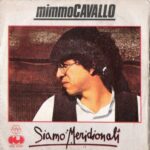
(Lizzano, TA, 1951 – )
By Francesco Ciabattoni, Georgetown University
Before Franco Cassano theorized his Pensiero meridiano in 2005, the Nuova Compagnia di Canto Popolare had already proposed a rediscovery of Italy’s south and its musical culture—its values, which are not merely the opposite of those of the North or the West, and its role in the new Italian singer-songwriter movement of the 1960s–1980s. The theme would garner interest from other artists, for example Luciano De Crescenzo and Claudio Mattone, who in 1983 wrote “Sud” for singer Pietra Montecorvino, in the soundtrack toFF.SS. (Federico Fellini Sud Story, directed by Renzo Arbore). With his debut in 1980, Mimmo Cavallo pursued a southern style in which the use of dialect (mostly Neapolitan, despite his Apulian origins) and themes of redemption—perhaps in line with Edward Said’s Orientalism (“C’è un vento che soffia da oriente… casa araba, araba,” [“There’s a wind blowing from the east… Arab house, Arab”] from “Taranta d’oriente” Anteros Produzioni, 2025), if indeed Cavallo had read the book. Starting with the 1980 album, he naturally blended blues and Anglo-American rock (“Tene e’ ccorna”) with a progressive sound (“Diavoli e diavolette,” which begins with the opening tercet from Dante’s Inferno!), classic ballads (“Anna, Anna mia”) and with tarantella rhythms (“Taranta d’oriente”). His debut hit (“Siamo meridionali,” 1980), which begins with an almost gospel tone, pokes fun at the clichés of southerners (“siamo fatti alla maniera tradizionale, / cardinali e vescovi, mezzi bianchi e mezzi neri / e quelli che non so’ preti, so’ carabinieri!” [“We’re Southerners, / we’re made in the traditional way, / cardinals and bishops, half-white and half-black, / and those who aren’t priests are carabinieri!”) while also displaying resources that might appeal to the author of Il pensiero meridiano (“Siamo meridionali e stiamo bene uguale senza neanche una lira” [“We are southerners and we’re just as well off without a penny”]). Cavallo asserts his southernism not without a few jabs at northerners, especially the Piedmontese (“e ci date aiuto ci basta pe ‘nu mése / e ce ‘mparamu tutti quante ‘o piemontese, nè?” [“and if you help us out, it’ll last for a month / and we’ll all learn Piedmontese, right?” from “Siamo meridionali”), the orchestrators of a one-sided Italian unity. “Siamo briganti” (2011) quite openly sides with the Bourbon legitimists against “Francìsi and Savoiardi / comu lupi affamati” (“Frenchmen and Savoy / like ravenous wolves”), vindicating the cause of the brigands, not unlike Eugenio Bennato’s 1979 “Brigante se more” or “Ninco Nanco.” Cavallo also emphasizes this point in other songs, for example “Uh, mammà!” questions the legitimacy of the conquest of southern Italy by the Piedmontese (1860, the “blue coat of arms” of the House of Savoy is their trademark) by asking the question of who will free us from the liberators:
So’ fratell’a noi, ci vengono a liberà!
Ci stanno occupando, uh mammà!
Il fatto è temporaneo, poi ci dovrebbero lasciare
Hanno aggiunto alla bandiera uno stemma blu, uh mammà!
Non sei più contento? Mo’ teniamo un colore in più![…]
E scappo via da casa, uh mammà!
“Che vai a fa’ là sopra ai monti, se neanche sai spara’?”(They’re our brothers, they’re coming to free us!
They’re occupying us, oh mammà!
It’s temporary, then they’ll leave us.
They’ve added a blue coat of arms to the flag, oh mammà!
Aren’t you happy anymore? Now let’s keep the extra color! […]
And I’m running away from home, oh, mammà!
“Why are you going up there to the mountains if you don’t even know how to shoot?”(“Uh Mammà” da Uh Mammà CGD. 1981)
In “Garibardo,” a rock ballad with hints of what likely inspired the music and theme of Sergio Caputo’s “Garibaldi innamorato” (CGD, 1987), the figure of Italy’s most famous national hero is hotly contested, to the point of questioning—with a refrain in Spanish—whether Garibaldi is truly a hero or instead a bandit and a puppet in the hands of the Savoy (“Eroe de la Nación o bandido? / han fatto quello che han voluto / t’hanno fregato, Peppi’!” [“Hero of the Nation or bandit? / they did what they wanted / they cheated you, Peppi’]!)
Cavallo continues to make music today in various styles and themes, such as the poignant “Oh Mimì” (Suoni dall’Italia, 2022), dedicated to Mia Martini, a singer for whom Cavallo wrote several pieces (for example, “Guarirò guarirò,” in Quante volte…Ho contato le stelle, DDD 1982), or the album Puesta del Sol Tango (Stranamente Music, 2017), in which the accordion also takes center stage on numerous entirely instrumental pieces (a particularly evocative one is “Violentango,” whose title is at least based on Astor Piazzolla’s famous “Libertango,” a version of which Cavallo also offers on his album). Even more recently, “’U vurpe” (Sounds from Italy/Believe, 2025) combines Taranto dialect with Anglo-American blues/rock in a beautiful ballad in which theriomorphism is a metaphor describing the inhabitants of his hometown Taranto: Cavallo “plays on the anthropomorphism of men and fish (sea bass, bogue, mackerel, octopus, etc.), all belonging to the people of the sea. The sea where we come from and where, willingly or unwillingly, we are destined to return. Sea as the womb of identity, a shining gem of lost and dispersed lives” (Broglia). These words of the former general director of Radio Italia Solo Musica Italiana give me the opportunity to bring the discussion back to southern Italy—never dormant in Mimmo Cavallo, as evidenced by the entire album Quando saremo fratelli uniti (Edel, 2011), but especially in “Tedeum Gaeta” and in “Ezechia da Verona,” which is inevitably, for a Taranto native, linked to the sea. The sea, seen from Taranto, is a cosmos that opens to the south and cannot help but be a bridge uniting peoples and countries, as Franco Cassano intuits (p. 78), looking toward Greece and the East:
Mediterraneo è un eroe sul delfino
un irlandese che diventerà patrono
terra di Paisiello, Federico e dei d’Aquino
è un ponte sul mare fra il tuo cuore e il mio cuscino[…]
La nostra memoria è la storia che si fa vita
sta nei vicoli bui, su ogni pietra scolpita
e vennero dal mare e vennero
e vennero del freddo raccontano
portarono il dolore portarono
portarono amore che avevanoE furono greci e saraceni e longobardi e bizantini
ed i normanni e musulmani gli svevi ed i romani,
gli antichi Italiani(The Mediterranean is a hero on a dolphin
an Irishman who will become a patron saint
land of Paisiello, Frederick, and the Aquinas
it is a bridge over the sea between your heart and my pillow[…]
Our memory is history that becomes life
it lies in the dark alleys, on every carved stone
and they came from the sea and they came
and they came they tell of the cold
they brought the pain they brought
they brought the love they had
And they were Greeks and Saracens and Lombards and Byzantines
and the Normans and Muslims, the Swabians and the Romans,
the ancient Italians)(“Mediterranea è” from Quando saremo fratelli uniti, 2011)
And as Fernand Braudel notes, the Mediterranean basin is both a divisive element and a vehicle between peoples; it is “a thousand things at once. Not one landscape, but landscapes without number. Not one sea, but a succession of seas. Not one civilization, but a number of civilizations, superimposed one on top of the other.” Leaving the floor to Pensiero Meridiano one last time, in conclusion, this brief introduction to Mimmo Cavallo perhaps captures the spirit of this coherent and innovative singer-songwriter well:
If we want to begin to think about the south again, some preliminary steps are necessary. First, we must stop seeing its pathologies as the consequence of a lack of modernity. We must reverse our perspective and begin to consider that, in southern Italy, modernity is probably not unrelated to the pathologies for which many still believe it is the cure. […] Reverse the relationship: do not think of the south in the light of modernity, but on the contrary, think of modernity in the light of the south. Thinking about the south, then, means that the south is the subject of thought: it must not be studied, analyzed, and judged by external thought, but must regain the strength to think for itself, to decisively reclaim its autonomy. Southern thought essentially means this: restoring to the south its ancient dignity as the subject of thought, interrupting a long sequence in which it has been thought by others. (Cassano, pp. 48-49)
Sources:
Official Site: https://www.mimmocavallo.it
Braudel, Fernand, Il mediterraneo. Lo spazio, la storia, gli uomini, le tradizioni, Newton Compton,2002.
Broglia Filippo. Recensione a “’U vurpe” https://earone.com/post/0e0dafdb28
Cassano, Franco. Il pensiero meridiano, Laterza, 2015 (2005) Said, Edward. Orientalism, New York: Pantheon Books, 1978 .
Translated songs: